Kids · a letter from Momma
Siblings fighting again: do I step in or stay out?
Why settling every fight makes them fight more, the three questions to ask before you walk in, and the one to stop asking.
Dear Momma,
It’s 5:40. The pasta water is nearly boiling, you’re halfway through an onion, and the shriek comes from the living room. It’s the third one in twenty minutes.
You go in, drying your hands on your jeans. Two children, one plastic dinosaur, and two completely different stories, both at full volume. You pick the likelier one, hand over the dinosaur, say something about taking turns. And the one you didn’t pick looks up at you with a face you’ll see again at midnight: “You always take her side.”
By bedtime you’ll have decided something like forty of these. And here’s the part that makes you want to sit down on the kitchen floor: nobody is better for it. They’re not fighting less. They’re fighting more, and more of it is aimed at you.
Most of what you’ve been deciding was never yours to decide. Who had the dinosaur first belongs to them, and so does the clumsy, loud business of sorting it out. That’s how children learn to share a world with other people, and every fight you settle for them is one they didn’t get to practice.
The fight is theirs. The house is yours.
What’s yours is bigger, and simpler. Nobody gets hurt. Nobody gets cruel. Nobody much smaller gets overpowered by somebody much bigger. The house is set up so they’re not crammed together at the worst hour with nothing to do. And each child knows, without having to fight for it, exactly where they stand with you.
A few lines hold for every child, whoever started it: no hurting bodies, no wrecking on purpose, no cruelty, no ganging up. They’re the same lines for the three-year-old and the nine-year-old. What changes with age is how much self-control you expect, not who wins. And the older one is never your deputy.
Who is the fight for?
The dinosaur is rarely the point. Underneath, it’s often place (who’s first), territory (my seat, my side), skills they don’t have yet (waiting, asking instead of grabbing), and you.
So before you go in, it helps to ask who the fight is for. Some are truly between them. Some run on an empty tank at five o’clock, and need a snack and separate corners more than a ruling. And some are partly for you: they start when you pick up the phone, get louder when you walk in, and end with your name. That isn’t a plot. In many houses, a fight is simply the fastest way to get a parent into the room. So make sure they get you at other times too. Answer the polite request as fast as the shriek.
Use it tonight: three questions, in order
When the shriek comes, ask these quickly, and do what the answer tells you.
- Is anyone being hurt, or about to be? If yes, go now, and go to the child who’s getting hurt first. Put your body between them. Any hands you need are for the hurt one. Then move them apart. No questions about who did what yet.
- Is there a difference in power? One much bigger, one much younger, two against one? Then it isn’t a fair fight. Go and stand right beside them. You don’t have to take a side. You just have to be there.
- Can they get there without you? If nobody’s hurt and they’re matched, let them work it through. That never means leaving. Stay in earshot, and in sight with little ones.
And stop asking “Who started it?” You’ll get two loud, partly true answers, and whichever one you believe, the other child loses twice. Try one of these instead:
- “I’m right here. Nobody’s getting hurt.”
- “You two are stuck. I’m going to stay while you sort it out.”
- “I’m not choosing. I’m listening.”
When it’s more than sibling fighting
If a child is seriously hurt, call your local emergency number now. If a child is injured beyond the ordinary bumps, get it looked at.
If one of your children seems frightened of a sibling, or is being hurt again and again, or singled out in a way that keeps going however you set things up, talk to your child’s doctor this week. You don’t need to try anything else first. If anything between your children has a sexual element that worries you, don’t wait and don’t carry it alone: talk to their doctor, or, if a child may be in danger, your local child protection services or the police.
And if you’re ever afraid of what you might do in the middle of it, put the children somewhere safe, step away, and call someone.
Most fights are theirs to work through. Knowing which ones aren’t is yours.
— Momma
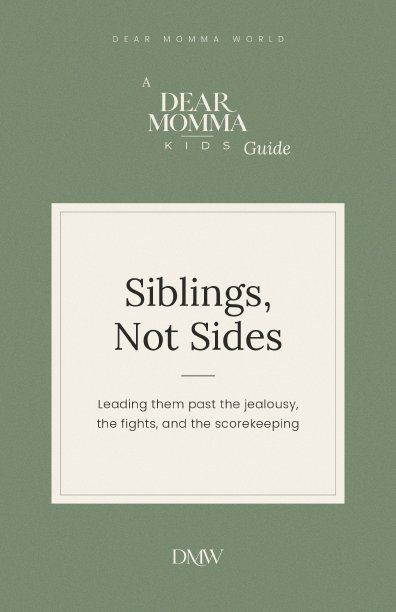
This letter draws on Siblings, Not Sides, the Kids Guide to siblings who won’t stop fighting: for the house where you referee all day, when to stay out, when to step beside them, and when to step in.